

Nicola Work, OFLA Editor for Electronic Media
Associate Professor of French, University of Dayton
Do you want to make your language class more engaging and fun? Do students seem disengaged and bored? Do you have a hard time getting everyone involved? Would you like to mix up your class routine? If you answered ‘yes’ to any of these questions, active learning might be for you.
What is Active Learning?
Active learning is any instructional approach in which all students are asked to engage in the learning process. This offers an opportunity for students in the class to think and engage with the course material and practice skills for learning, applying, synthesizing, or summarizing that material. Meyer and Jones (1993) describe active learning as “providing opportunities for students to meaningfully talk and listen, write, read and reflect on the context, issues, and concerns of an academic subject” (p. 6).
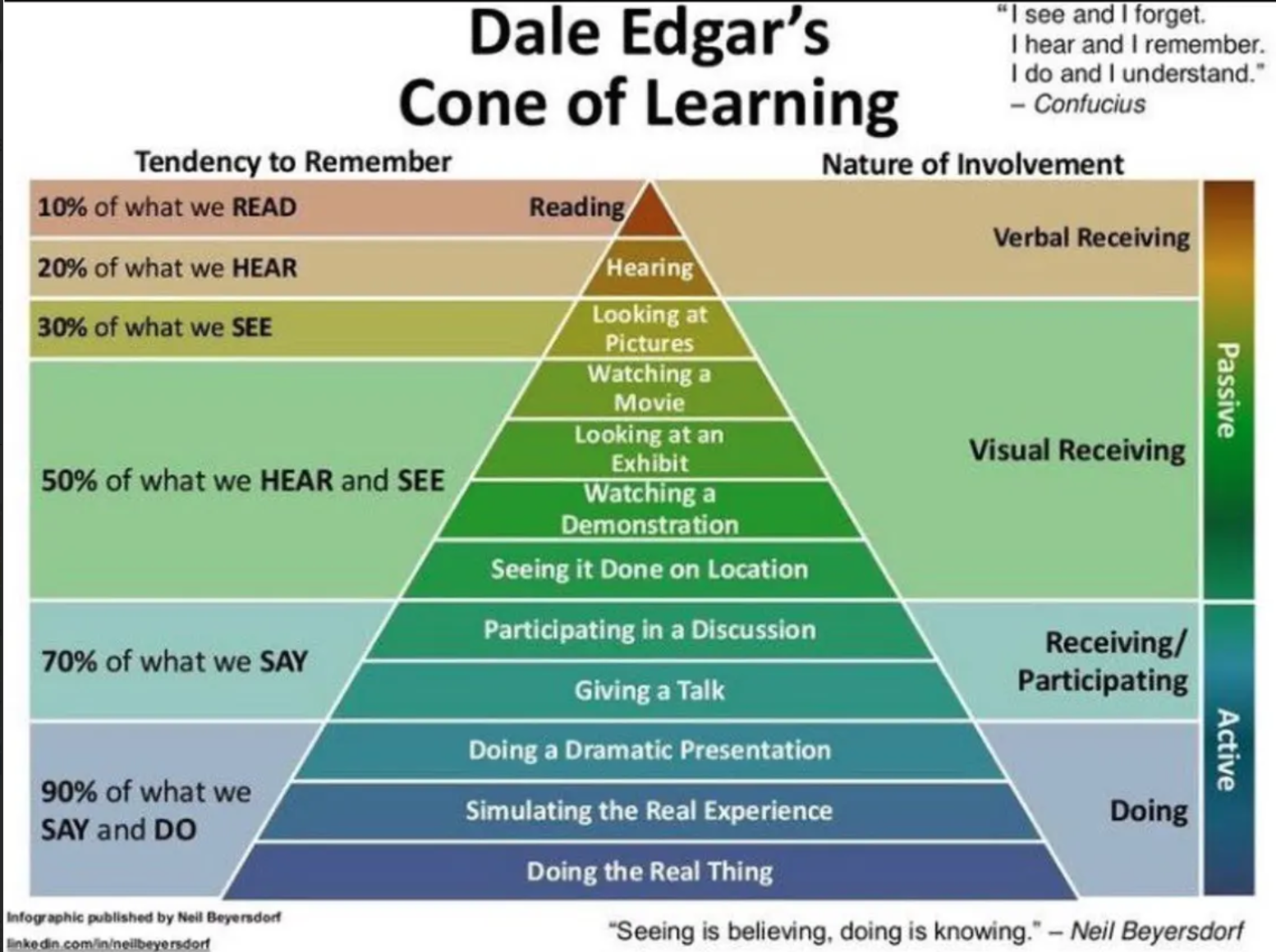
Active learning is student-centered as students take more responsibility for their own learning; the teacher, in turn, assumes the role as facilitator, guide, coach. Active learning often encompasses discovery learning, problem-based learning or inquiry based learning. Students learn by doing rather than by lecture. Research about active learning found higher levels of student achievement and personal development, increased course grades, and increased student motivation (Cavenagh 2016; Freeman et al., 2014; Kuh, O’Donnell, Schneider, 2017; Owens, Sadler, Barlow & Smith Walters, 2017). A look at Dale Edgar’s Cone of Learning indicates that active learning leads to higher levels of retention compared to passive learning such as lectures or watching a video.
Ideas for active learning in language classes
Active learning to boost student engagement can be used in all language classes regardless of language studied and proficiency level. Many active learning activities take very little time to prepare but can have a lasting impact on student learning and retention. The following teaching ideas can easily be adapted to fit each instructor’s needs.
Interactive whiteboard or sticky notes:
An interactive whiteboard (such as Google Jamboard, Figjam or Canva) or sticky notes can be used collaboratively to practice or review vocabulary or grammar structures. Students answer questions such as ‘What are you wearing today?’ or ‘What did you do last weekend?’ by putting their responses on the board or on sticky notes. Interactive whiteboards or sticky notes can also be used for brainstorming, close readings, definitions, outline of a story or reading, collaborative writing, character descriptions, picture descriptions, and so much more.
Dice games:
Rolling dice – whether using real dice or virtual/online dice – is a great tool for active learning. You can use dice as conversation starters (based on a grid with numbers 1-6 across the top and 1-6 down): students roll two dice and use the grid to find the topic of conversation. Dice can also be used as a fast conjugation practice (based on a grid with numbers 1-6 across at the top with 6 verbs and 1-6 down with the person in which to conjugate). Students roll and conjugate the verb accordingly. This can also be done with one dice – the same verb is given to the class and by rolling the single dice the person in which to conjugate is determined. There are many other possibilities to use dice in the language class such as practicing numbers, reviewing vocabulary, answering questions, etc.
Drawing:
Drawing is another easy to implement active learning activity that can be used in many different ways. Whether students draw in groups on a whiteboard or have individual whiteboards at their tables or even use paper the possibilities are endless. Pictionary can be used to practice or review vocabulary at all levels. One student draws the word, the others guess. This can be done in teams or small groups or as a whole-class activity. Students can also draw what they hear. This could be a description of a place, room, or person or a story or fable. To demonstrate understanding, students draw what was described. Learners can also diagram the story of a film or a book to show understanding and in turn, practice their retelling skills.
Games:
Games are another easy way to incorporate active learning into the class. They do not need to be elaborate games; they can be as simple as Bingo to practice numbers or words, Simon says to work on commands, Two truths and a lie for speaking practice, UNO to practice numbers and colors, Charades, Pictionary, or Fly Swatter for vocabulary review and practice, Wordle for vocabulary, and so much more.
In conclusion, active learning can be easily incorporated into language classes of any level to boost student engagement. Many of the above mentioned ideas require little or no preparation, but can have a huge impact on learning and motivation. Give it a try and have fun – especially as we are nearing the end of the school year!
Bibliography:
Cavenagh, S. (2016). The spark of learning: Energizing the college classroom with the science of emotion. Morgantown, WV: West Virginia Press.
Freeman, S., Eddy, S.L., McDonough, M., Smith, M.K., Okoroafor, N., Jordt, H., &
Wenderoth, M.P. (2014). Active learning increases student performance in science, engineering, and mathematics. Proceedings of the National Academy of Sciences 111 (23) 8410-8415. https://doi.org/10.1073/pnas.1319030111
Kuh, G., O’Donnell, K., & Schneider, C. (2017). HIPs at ten. Change, 49(5), 8-16.
Meyer, C., & Jones, T. B. (1993). Promoting active learning: Strategies for the college classroom. San Francisco: Jossey-Bass.
Owens, D., Sadler, T., Barlow, A., & Smith-Walters, C. (2017). Student motivation from and resistance to active learning rooted in essential science practices.
Research in Science Education. https://doi.org/10.1007/s11165-017-9688-1
 The Cardinal