
Sites of Death & Cultural Destruction
Dr. Roger W. Anderson, Independent Scholar
Pope Paul II declared in 1537 that indigenous people of the Americas were indeed human beings with souls that could be “saved” (Pluralism Project). European colonization then embraced evangelizing. This article describes two regions of such activity: California and Ontario/Quebec.
Sainte-Marie-au-pays-des-Hurons
The first European settlement in Ontario, located near the Georgian Bay, was established by French Jesuits to convert the Huron-Wyandot people in the 17th century. The mission only lasted 10 years, and concluded when the French decided to burn it rather than let it fall into the hands of the attacking Iroquois (Sainte Marie Among the Hurons, 2024). These raids, which continued for 70 years, are known as the “Beaver Wars” or the “French and Iroquois Wars”. The conflict was sparked by British, French, and Dutch competition for dominance of the trapping and trading of beaver pelts, implicating rival alliances with American Indian tribes (Parrott & Marshall, 2019). Beaver pelt men’s hats became a pan-European fashion craze.
Today, the reconstructed fort at this site allows visitors to experience a tour with historical reenactors (one tour daily in French; see website.) This and other missions were the sites of religious coercion and ultimately the destruction of a people and its culture. One historian wrote, “The Indian who embraced Christianity was compelled, in effect, to commit cultural suicide. He was required to renounce not only his own personal past, but that of his forefathers as well, forsaking and despising all traditional beliefs and practices” (Ronda, 1977, p. 67).
California’s Missions
A network of 21 settlements stretched from San Diego to just north of the San Francisco Bay. These Spanish missions functioned from 1769-1833 to westernize the indigenous people (History Channel Editors). The network was managed by Father Junípero Serra from the mission/basilica in Carmel (see Image 2), which remains one of the oldest structures in California (see website). There, 800 American Indians lived and worked the land. Yet the mission’s extensive museum makes no mention of encomenderos, private contractors throughout New Spain who used Indian labor and coerced them to remain within the Jesuit settlements (O’Donnell, 2020, p. 19).

Harsh truths about Father Serra’s missions confront visitors to the nearby Santa Clara mission. See Image 2. Before he established the missions, American Indians of today’s California numbered 300,000 and was among the most culturally and linguistically diverse places on earth. By 1834, only 20,000 remained (History Channel Editors).
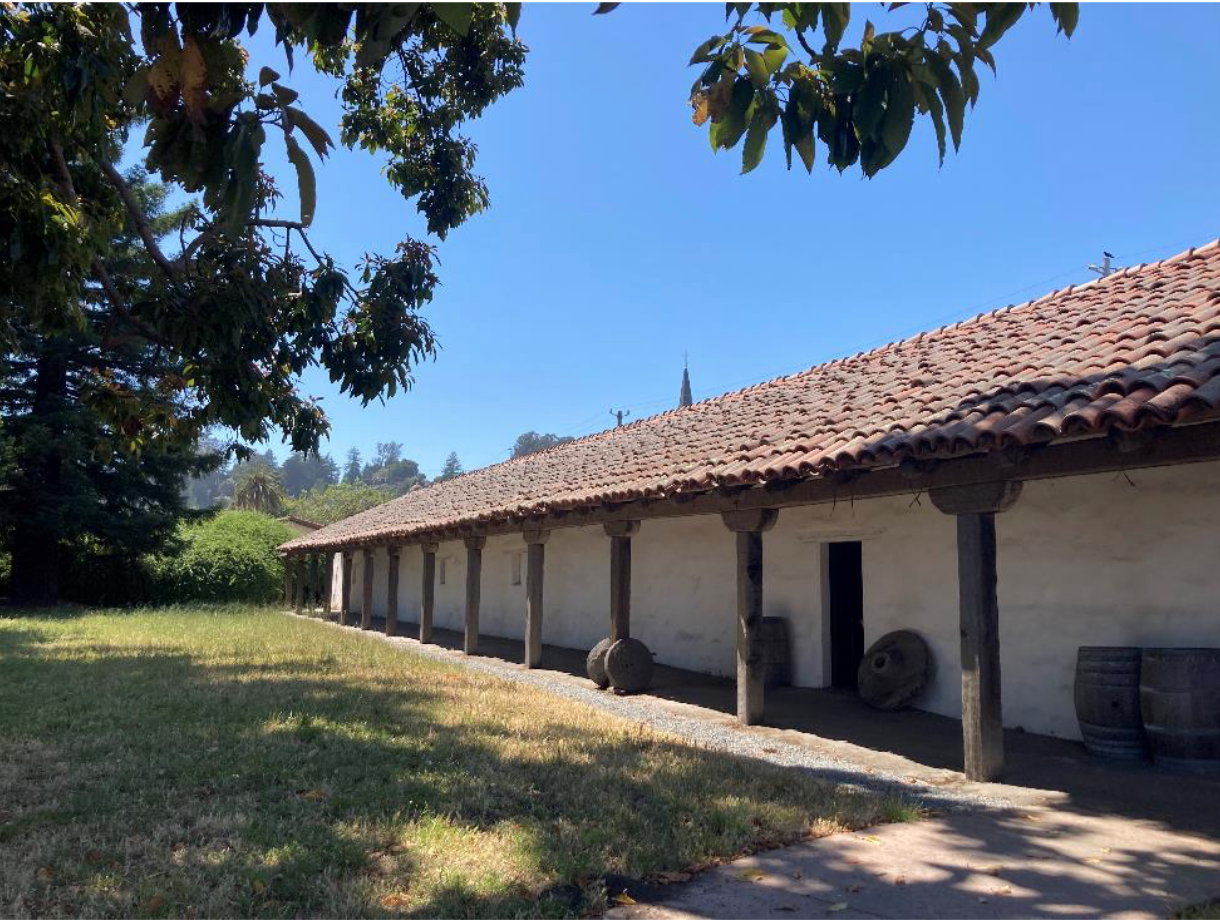
managed by California State Parks
At Santa Cruz, major population decline was not due to measles and smallpox, of which three outbreaks occurred. Instead, it was syphilis (which did not exist in North America prior to European arrival) that left its victims sterile (Jackson, 1983, pp. 38-40). Intentional or otherwise, “Franciscan missionaries at Santa Cruz mission presided over the collapse of the demographic collapse of the local Costanoan/Ohlone population in the north Monterey Bay” (ibid, p. 53). A small cemetery sits behind the Carmel Basilica where American Indian graves are honored with colorful abalone shells. See Image 3. Thousands more shells are needed if each shell is meant to honor the memory of every American Indian killed at the missions.
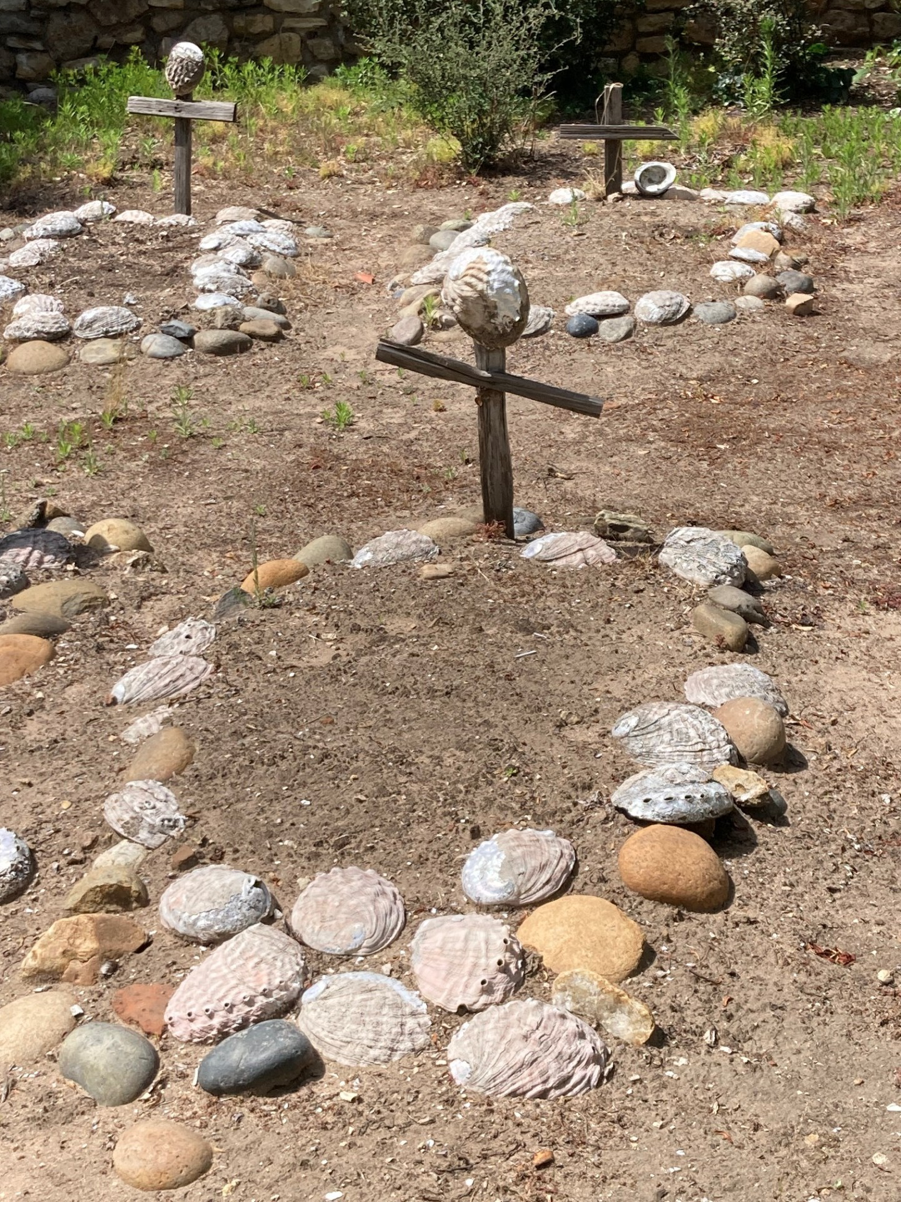
Questioning awareness
Missionaries were not ignorant of their connection to these fatal diseases. One French missionary to the Huron in Quebec recorded: “no doubt we carried the trouble with us, since, wherever we set foot, either death or disease followed us” (Ronda, 1977, pp. 72-3). Amongst the Huron, disease and death became associated with the rite of baptism. Jesuits initially withheld baptism from converts until the moment before their death to ensure they would not revert to indigenous customs (ibid, p. 72). Later, Jesuits began baptizing society’s weakest: the young and the elderly, which provided observable evidence justifying the natives’ fears of baptism (O’Donnell, 2020, p. 9). Later still, baptism justified missionaries’ removal of baptized children from their unbaptized parents and the creation of boarding schools (ibid, p. 8). See memorialization in Image 4.
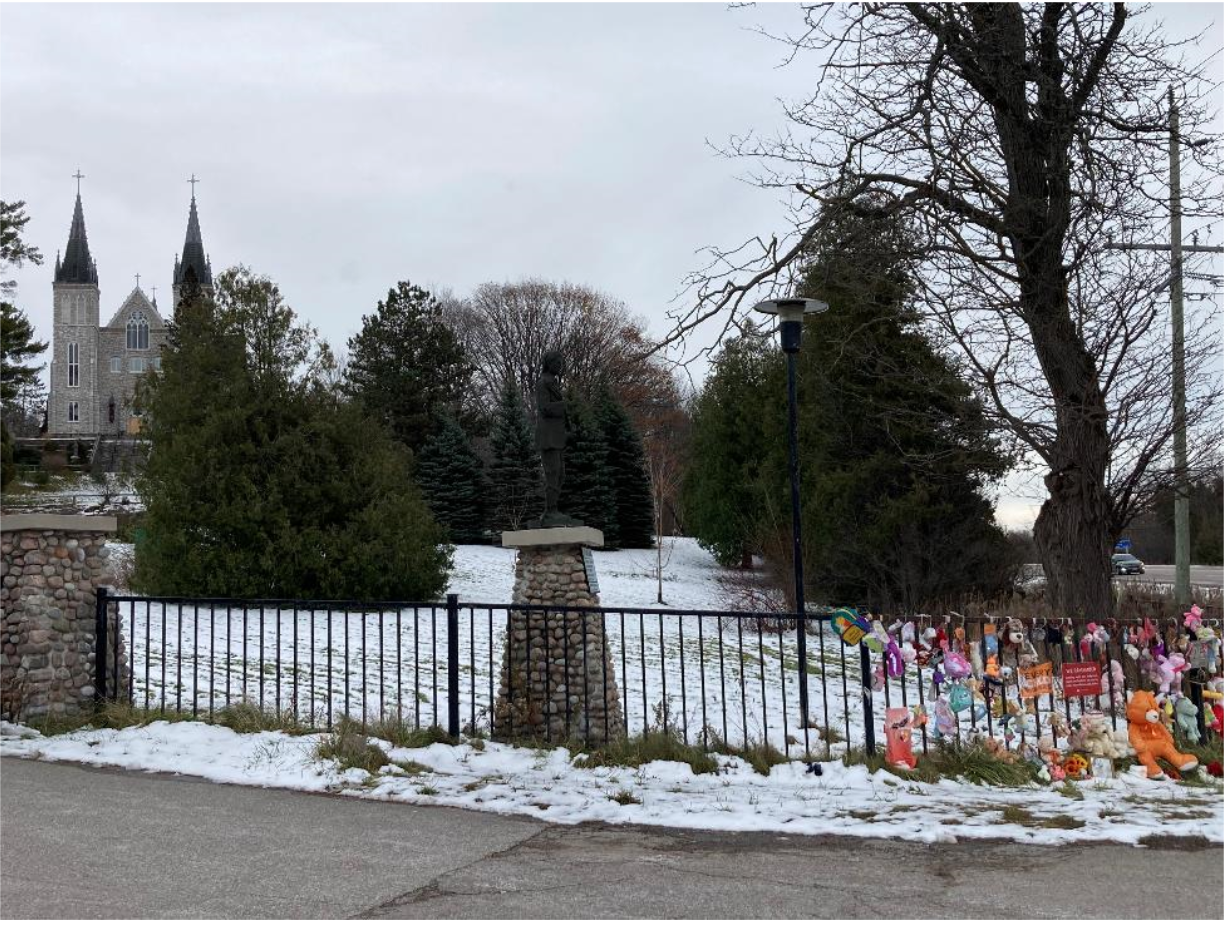
Complicating Narratives
The image of benevolent, peaceful Christian missionaries living in the forest among the people is a narrative that demands scrutiny. Centering the voices of the evangelized, one article entitled “We are well as we are” criticized the one-sidedness of historians’ account of 17th century Christian proselytizing amongst North American Indians. It recounted anecdotes from historical sources, providing depth to the cultural, social, and theological conflicts provoked by evangelizing. One anecdote recounted resistance to Christian theology: “When a Jesuit urged a Huron to acknowledge her sins and be baptized, she and her friends protested that she had always lived in innocence and without sin. The woman clearly rejected the Christian insistence that a person who lived a moral life might also be a great sinner” (Ronda, 1977, p. 69).
In 2015, Pope Francis canonized Father Junípero Serra, calling him “one of the founding fathers of the United States”. American Indian groups vociferously protested. They lamented the historical amnesia and the ethnocentrism that ignore the meaning of the California missions to the surviving indigenous people of California. Nonetheless, not only is Serra a Catholic saint, but his statue represents California in the U.S. Capitol’s Statuary Hall alongside that of Ronald Reagan (ABC News).
References
ABC News. (2015, Sept. 23). Why Pope Francis’ canonization of Junipero Serra is so controversial. https://abcnews.go.com/US/pope-francis-canonization-junipero-serra-controversial/story?id=33961080
Pluralism Project. (2020). First Encounters: Native Americans and Christians. Harvard University. https://pluralism.org/first-encounters-native-americans-and-christians
History.com Editors. (2018, Aug. 21). California Missions. History.com. https://www.history.com/topics/religion/california-missions
Jackson, R. H. (1983). Disease and Demographic Patterns at Santa Cruz Mission, Alta California. Journal of California and Great Basin Anthropology, 5(2). Retrieved from https://escholarship.org/uc/item/0xc0q4x0
O’Donnell, C. (2020). Jesuits in the North American Colonies and the United States: Faith, Conflict, Adaptation. In Jesuits in the North American Colonies and the United States: Faith, Conflict, Adaptation (pp. 1–112). Brill. http://www.jstor.org/stable/10.1163/j.ctv2gjwn2q.3
Ronda, J. P. (1977). “We Are Well As We Are”: An Indian Critique of Seventeenth-Century Christian Missions. The William and Mary Quarterly, 34(1), 66–82. https://doi.org/10.2307/1922626
Parrott, Z. & Marshall, T. (2019, July 31). The Iroquois Wars. The Canadian Encyclopedia. https://www.thecanadianencyclopedia.ca/en/article/iroquois-wars
 The Cardinal