
Exploring Día de los Muertos in a Central California Town
Dr. Roger W. Anderson, Independent Scholar
Now living in California, I enjoy opportunities to deepen my understanding of Hispanic cultures and practice my Spanish. In Fall 2024, our local newspaper announced Día de los Muertos celebrations in King City, a small city at the south end of Monterey County. Located in agriculturally rich Central California, King City is home to 8,000 inhabitants, approximately 85% of whom are Hispanic. For those not familiar, Día de los Muertos loosely compares to the American holiday of Halloween. Yet for Mexican-Americans of California, my understanding is that the holiday is far more spiritual than commercial.
Mexican-American Pride
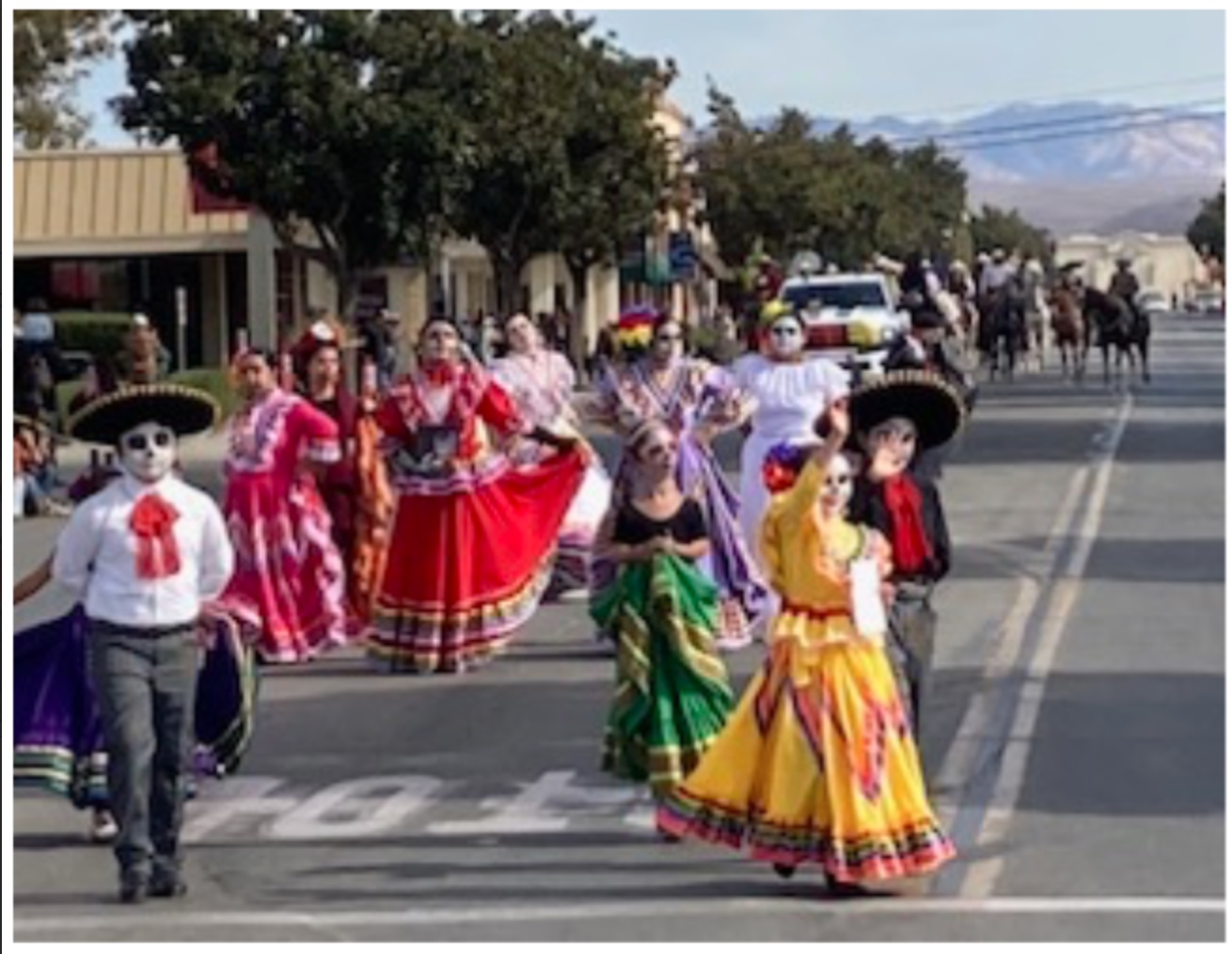
A charming parade made its way through downtown King City against the backdrop of the dusty Santa Lucian mountains. The parade was led by a giant motorized skeleton, followed by a pick-up truck carrying ghouls. These ghouls waved a peculiar flag– half the Stars and Stripes, the other half the Mexican flag. This flag symbolizes the unique, blended culture of these Mexican-American parade marchers and this community. See Image 1.
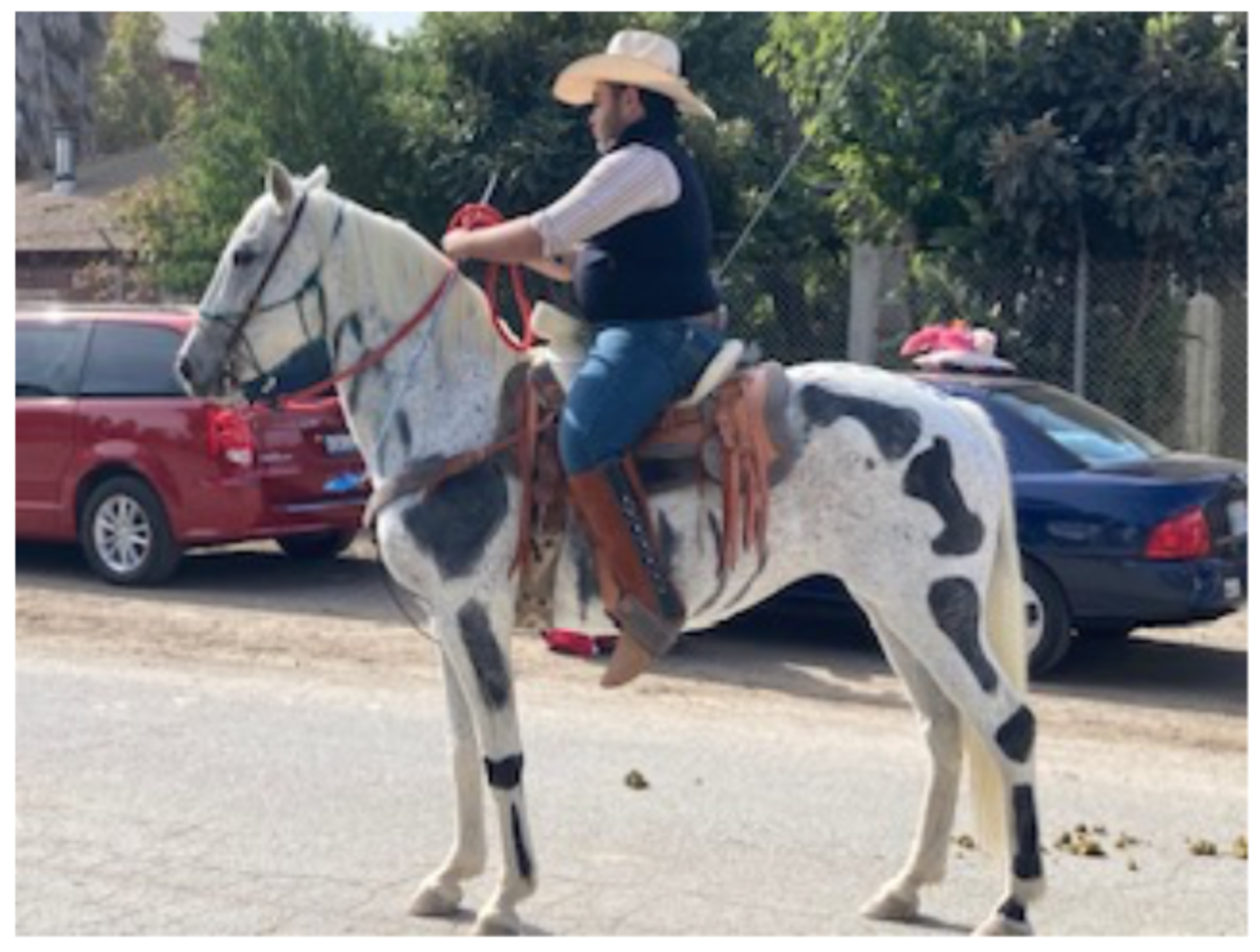
The Cowboy is a longstanding part of California’s cultural heritage and remains vibrant today. For Día de los Muertos, horses painted to wear their skeletons on the outside paraded through downtown.
Lacking a grand-marshal, La Llorona nevertheless stole the spotlight. The terrifying femme fatale of Mexican lore was embodied by a woman on horseback covered in fine black lace, leaving none of her skin exposed. La Llorona later turned out to be a friendly woman with no reservations against posing for photographs for her admirers.
The parade proceeded to the fairgrounds, which were decorated with strings of orange mums draped from sycamore trees. An open-air stage was used for numerous dance groups, musicians, and ultimately, a sort of fashion show-contest in which “La Catrina” and “El Catrín” (the the adjective meaning ‘elegant’) were chosen as the best-disguised, and thus earned the role of embodying the king and queen of death, of sorts. Opposite the stage, kids in costumes roamed the fairgrounds, where vendors were selling all sorts of goods, savory foods, and sweet beverages.
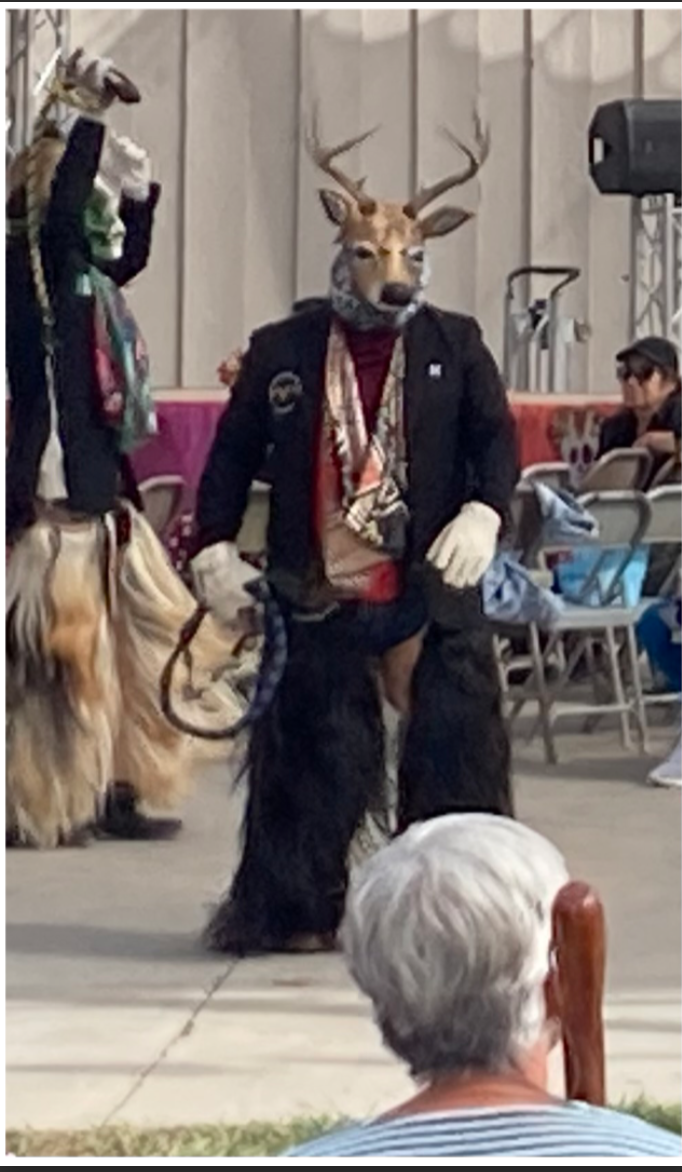
I devoured a plate of corn-tortilla tacos, then a hot, cinnamon-sugared churro, while watching a performance of antlered men cracking whips on stage.
A Very Human Holiday
I followed a sign indicating the way to a “Room of Altars.” Inside, a darkened room awaited in which six distinct altars had been assembled around the room’s periphery. In the center of the room, a giant screen with chairs allowed attendees to watch a video on loop displaying family photos of community members who had passed away. Sorrowful guitar music created a heavy ambiance in the space.
“Are you with the newspaper?” a woman asked. I explained I was just a language teacher and consummate Spanish language learner. She welcomed me and offered riveting explanations of her community’s traditions.
She explained that the altars were assembled by individual families to honor their departed loved ones. Each altar was unique, elaborate, and multi-tiered. They comprised brightly colored table cloths, flowers, fruits and snacks, lights and candles, framed photographs, and various knickknacks including bottles of favorite alcohols. The woman explained that the consumables represent favorites that the departed family members enjoyed in life. See Image 4.

Loved ones, though departed, remain with us so long as we remember them, she explained. Altars included pictures of beloved pets: dogs, cats, horses, and even a pig!
The woman also acknowledged that Spanish colonialism brought Catholicism, which was grafted onto indigenous beliefs and traditions, including those underpinning this holiday. For her welcome and for her explanations, I am grateful to this cultural ambassador. I know that I have only but scratched the surface of this region and its culture.
For any human with at least a part of a soul, it would be difficult to attend this Día de los Muertos celebration and not be moved. Everyone has experienced the loss of a loved one and felt the sadness of their absence. Whatever the origins of the holiday are, this celebration offers a very healthy and comforting understanding of loss.
I couldn’t help but think of my own favorite human, my aunt, whose passing still feels recent. More of a homebody, she was less eager to explore unfamiliar environments than me, but she raved about visits she made when living outside the U.S. Although she didn’t love Halloween, she would have loved King City’s charming celebration, music and dance, food and family.
Conclusion: “para gustos hay colores” (to each their own!)
The following Monday, a fellow teacher inquired about my weekend. I explained the great adventure I had immersing myself in California’s Mexican-American culture. She expressed her opposition to my adventure, explaining that Halloween and all things death-related are antithetical to her religious values. Celebrating death is antithetical to Christianity, the faith to which she ascribes. Funnily enough, I had not even asked for her opinion on the holiday.
Being at work, I chose to acknowledge her right to disapprove and went about my routine. Religion and politics are topics that are not to be broached at work, according to our mandatory training.
Here in the United States, she has the right to celebrate or not celebrate whatever holidays she chooses, however she chooses, –even as a non-U.S. citizen nor permanent resident. She is also free to criticize what I find to be beautiful, important, or true. I believe that an individual’s freedom to decide the course of one’s own life, one’s culture and beliefs, and one’s ability to publicly express these beliefs, is one of the two pillars of American greatness. The second is its incredible diversity.
Celebrating Día de los Muertos in King City, California, reminded me of both. As world language professionals, we must embody these values, both to our students and within our workplaces and communities.
*Me gustaría dedicar este artículo a la memoria de mi querida tía, AT, a quien recuerdo diariamente para que se quede con nosotros en este mundo.
 The Cardinal