Steven J. Sacco, Professor Emeritus, San Diego State University, and President of Sacco Global Consulting
Ashli Sambaluk, World Language Coordinator, Lewisville, Texas School District
“Africa is the continent of the future,” proclaimed French President Emmanuel Macron, and the need for French-speaking professionals in global business, philanthropy, diplomacy, sustainability, the military, and education has never been greater. Consequently, on August 7, 2024, the U.S. Department of Education awarded the American Association of Teachers of French (AATF) a $114,972 grant to take a team of 14 curriculum development experts to Côte d’Ivoire to develop teaching units for K-16 French-language educators.
The mission, as stated by AATF Executive Director Megan Diercks, was to “decolonize the French curriculum” in preparation for employment opportunities for our graduates in Francophone Africa. The interdisciplinary Francophone African curriculum includes language, culture, history, geography, economic and political systems, literature, art, music, dance, cooking, and storytelling. The modules and materials are designed to meet the current and future geopolitical and socioeconomic needs of the United States in Africa, where French speakers will be needed in great supply. Several economists predict that Africa will become the new China in terms of economic success, and by 2075, Francophone Africa is projected to surpass one billion French speakers.
I ni ce! Bonjour! Hello! I’m Ashli Sambaluk, one of the 14 AATF group members selected to serve as a curriculum development “expert,” as our wonderful group leader, Steven Sacco, always calls us—with his trademark encouragement and positivity. I currently serve as the World Language Coordinator for the Lewisville, Texas Independent School District. I am also the past president on the Executive Board of the AATF’s North Texas Chapter, so this opportunity came to me as a chance to bring back tools for two very important audiences I always have on my mind: French teachers and French learners.
There are many reasons why being on the Fulbright-Hays GPA was important to me, but one of my biggest motivators was that I was able to work on a project of my choosing, focused on an outcome I am passionate about and see a need for. Working in curriculum, I am constantly disappointed by the lack of variety and representation of the Francophonef world available in free, authentic resources.
When students reach upper-level French courses, more global materials are accessible to them. However, we typically have very limited instructional time to “hook” them—often just 1-2 years. Therefore, providing engaging, motivating materials where learners can see themselves, both present and future, must happen at the novice level—precisely where these resources are the most scarce.
With little-to-no video-making skills, minimal Canva experience, and a new microphone for my iPhone (thanks Amazon!), I set off across the Atlantic with an idea: to collect authentic videos on everyday topics that would be engaging and comprehensible to novice learners.
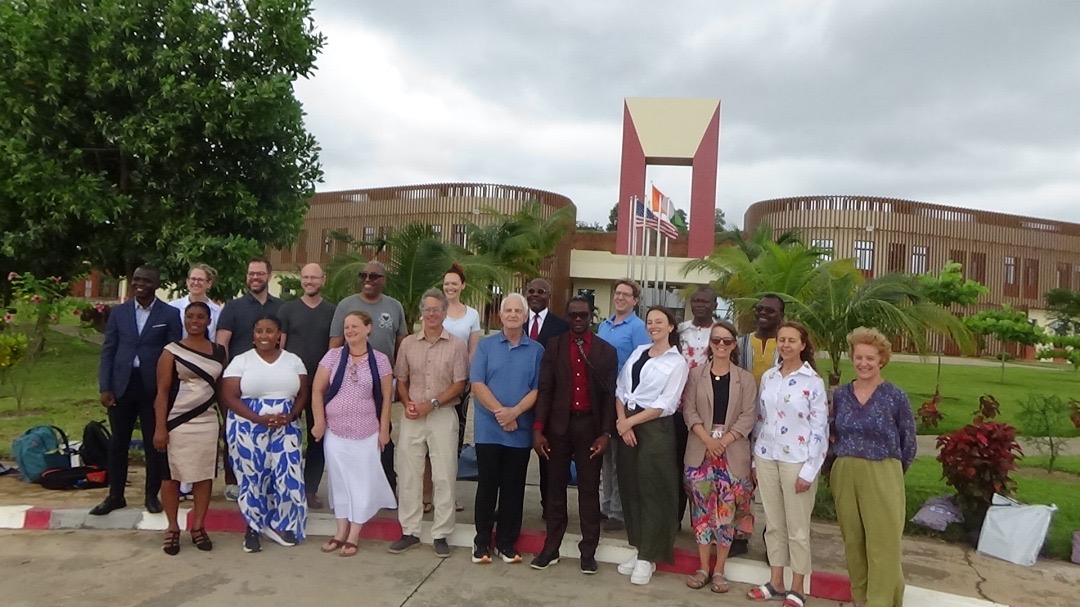
Upon arrival in our host city of San Pedro, the team buzzed with their project ideas. This sharing energized us all with possibility and sparked excitement about what each person and team would ultimately create. A shared goal connected me with my incredible teammate, Dr. Habiba Boumlik, whose collaboration brought more depth to the project as we brainstormed topics and tasks appropriate for novice learners in secondary and post-secondary French courses.
Everywhere we went in Côte d’Ivoire, we encountered Francophones excited to talk with us and to share their language and culture with students learning French. From simple introductions, to family and friends, student life, hobbies, and food, our gracious Ivorian hosts shared special aspects of Ivorian life. They showed us the fun of challenging friends and family to a strategy-based and addictive match of the traditional Ivorian game Awalé. They also shared the importance of time together, their love for their family members, and all the delicious details of garba—a beloved street food consisting of attiéké, tuna, onions, tomatoes, and fresh peppers; alloco—ripe plantains sliced and deep-fried until caramelized and tender; as well as the healing powers of Gouagouassou, a comforting and nourishing Ivorian stew.
Students watching these videos will fall in love with Loïse, a fascinating university student with the brightest smile; Dr. Brindou, a professor of English who is full of passion and laughter; and the protective, kind and karaoke-loving Natacha, Executive Secretary to the Vice President of the Université Polytechnique de San Pedro, along with many more amazing people of various ages and backgrounds.
As learners get to know each of our video stars, they will practice understanding main ideas, inferring the meaning of new vocabulary, and expressing their own views on a variety of everyday topics. I believe they will be inspired to continue exploring the vast cultures and identities in the Francophone world as they grow in proficiency, thanks to the warmth and enthusiasm of the Ivorians who participated in this project.
In between recordings, as well as after our return, Dr. Boumlik and I worked to provide fully implementable lessons, from novice learning objectives based on language functions to aligned summative assessment prompts. We created ready-to-go slides incorporating our video interviews, along with interpretive activities to help students make the most of the input.
We know how much time it takes to find appropriate authentic resources and create excellent classroom activities. We hope our work will support our fellow French teachers nationwide. We also dream that our project will help capture the love of beginner French students everywhere, as they have more opportunities to see their present and future selves as French users!
The Fulbright-Hays project materials will soon be available at no cost to French-language educators and students worldwide via the AATF website.
 The Cardinal