

Megan Helgeson, OWLA Beginning Teacher Chair
French Teacher, Miamisburg High School
Most teachers hate the modified schedules, shortened periods, and mentally drained or missing students that come with state testing season. I, on the other hand, love state testing time because it gives me the excuse to do only proficiency activities. With testing being toward the end of the year, proficiency activities can be a good review of what students know, and it does not matter whether classes do the same activities or not. Here are some of the activities I do with students the first year I have them. Visit Immersion in Motion for all of the activities I do, as well as how I modify some of these activities for subsequent years.
The First Year I Have Students:
Scattergories
Hand out, or have students get out, a scrap piece of paper. Explain that you will pick a letter, and for one minute students will write words that start with that letter. Those are all the directions I give to start. Have students choose the letter. After the minute is up, tell students that you will go around the room and everyone will read their list of words.
As the first person reads their list, write the words on the board and confirm how each word is spelled in case of homonyms. After each word, ask the class if anyone else has that word. If so, cross out the word on the board and tell students that anyone who has that word needs to cross it out, too. Continue this for every student. At the end, the student with the most words that are not crossed out wins. Repeat with other letters.
Object Search
Divide the class into two teams. Hand out highlighters and this handout of drawn objects. On the board, write “Team 1” and “Team 2” in order to keep score, write “I’ve got it” or “I found it” in the target language, and draw a rectangle to represent the piece of paper.
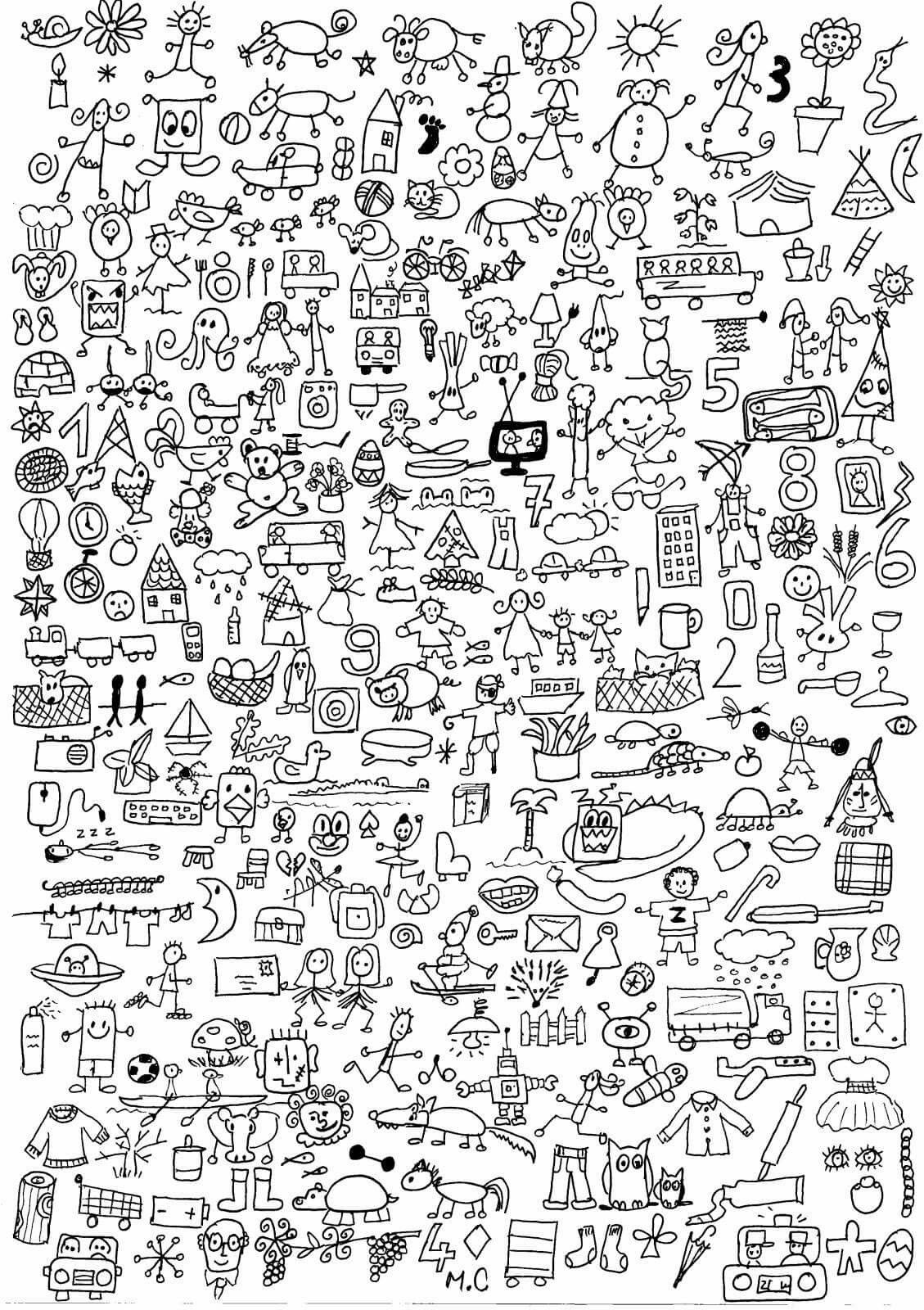
Explain to the students that you will say an object, and the first team to find the object and say “I’ve got it” earns a point. Emphasize that saying “I’ve got it” is necessary. (It is not based on who raises their hand first.) Then say “I see…” followed by an object. The first team to find the correct object and say “I’ve got it” gets a point. After verifying that the object is the correct one and giving the team a point, indicate on the rectangle where the object is so all students can highlight it.
Telephone
Have students get in groups of five to six. Then have them sit in a circle with their backs facing the inside of the circle. Pass out cut-out strips of the following telephone game, asking students not to look at the paper until everyone has received one. (Pass out papers in order, 1-6, to each group. If there are only five to a group, you would only pass out papers 1-5.)
Explain that students will read the sentence on their paper and draw an image in the box below for one to two minutes. As students draw, walk around and make sure each student is drawing in the correct box. After the time is up, show the students how to fold the paper so that only the image is showing. Have students hold up their folded papers to confirm that they folded them correctly.
Next, have students pass the paper to the right and explain that they will now look at the image and write a sentence describing it. Again, walk around as the timer is going to make sure students are writing and not drawing. Continue this process one more time for drawing and one more time for writing, each time allowing only the previous box to be visible.
Finally, have the students turn to face their groups and unfold the paper. Have students read the original sentence and final sentence to see if there are any funny changes to the sentences. Have students share out, then ask if there are any sentences that stayed close to the original.
Ten Questions
Explain to students that you will think of an object and they will have ten questions to figure out what it is. Encourage them to ask broad questions to eliminate categories. I allow questions to be yes/no questions or questions with specific answers, such as “What color is it?” Keep track of how many questions have been asked on the board.
After the first round, ask for student volunteers. Have the student come up to the front of the class and whisper to you what the object is and/or write it down secretly. As students ask questions, help the volunteer answer the questions, if necessary.
Password
Have students sit or stand in two lines facing a partner, with one line facing the board and the other line with their back to the board. Explain that you will write three vocabulary words on the board, and the students facing the board will describe the first word to their partners. Once their partners have guessed the word, they can move on to the next word.
After a partner has guessed all of the words, the pair should raise their hands. The first team to finish earns two points, and any other team that finishes before 30 seconds is up earns one point. Write three words and start the timer, then point to whichever team finishes first until 30 seconds is up. Tell students to remember how many points they have and then switch roles. Repeat several times, finishing with a tiebreaker if needed.